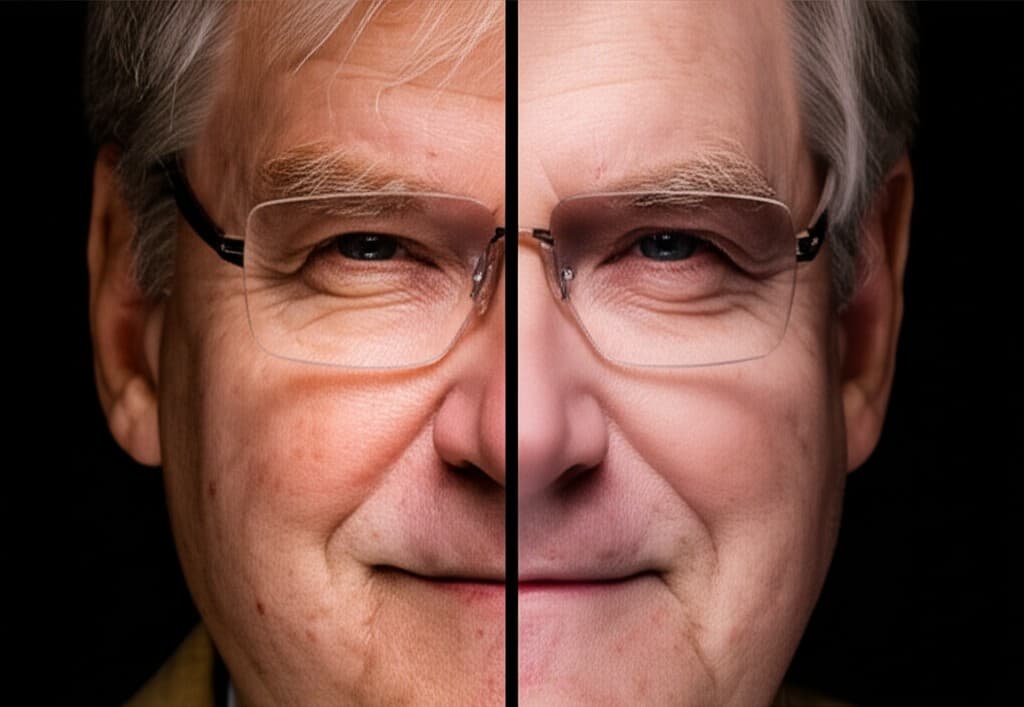
Open LinkedIn right now and scroll through your feed. Within seconds, you'll spot them: AI-generated headshots with their telltale porcelain skin, oddly symmetrical features, and that uncanny "almost human" glow. Tools like Midjourney, DALL·E, and dedicated "AI headshot" apps have made it trivially easy to fabricate a professional portrait without ever sitting in front of a camera.
And yet, every time you see one, something feels… off.
The Uncanny Valley Is Real
Generative AI is extraordinary at assembling pixels that look like a person. What it cannot do is capture the micro-expressions, the subtle asymmetries, and the lived-in quality that makes a face genuinely yours. A real headshot records the exact way your eyes crinkle when you smile, the confident tilt of your chin, the warmth that puts a colleague at ease in a meeting. AI doesn't know those things about you—because they come from life, not from a prompt.
Research in cognitive psychology confirms that humans are hard-wired to detect subtle facial anomalies. When a portrait looks "too perfect," it triggers distrust rather than admiration. In professional contexts where credibility is currency—law, finance, consulting, healthcare—that split-second gut reaction can cost you a connection before a conversation even begins.
Trust Is Built on Authenticity
A professional headshot isn't just an image; it's a promise. It says: "This is who you'll meet when we sit down together." When your LinkedIn photo is a fabricated version of you, that promise is broken before it's ever made.
Studies show that profiles with professional (real) headshots receive 14 times more profile views than those without, and recruiters consistently rate authentic images as more trustworthy. Companies are beginning to flag AI-generated profile images, and some enterprise clients already require verification that submitted headshots are photographs of the actual person.
The Things AI Can't Replicate
- Context and environment: A real session captures you in professional lighting designed for your skin tone, features, and wardrobe—not a generic model's.
- Direction and coaching: A skilled photographer guides your posture, expression, and energy in real time. That collaborative process produces images that feel natural because they are natural.
- Consistency across a team: When a company invests in professional headshots, every team member receives imagery with matching lighting, backgrounds, and quality. AI tools produce wildly inconsistent results from person to person.
- Emotional resonance: The best portraits convey warmth, competence, and approachability simultaneously. These qualities emerge from a real human moment—not from a text prompt.
The Business Case for Real Photography
Brand consistency is a measurable driver of revenue. Inconsistent visuals—varying backgrounds, lighting styles, and crops—subconsciously signal organizational disarray. A unified visual identity acts as a shortcut for trust, telling clients and investors that your company is disciplined, cohesive, and detail-oriented.
In industries built on trust—banking, law, consulting—the differential in perceived competence between a professional portrait and an amateur or AI-generated one can swing as high as 115%. That isn't a vanity metric; it's a competitive advantage.
Our Take
We're not anti-technology. We use advanced lighting, tethered shooting, and professional retouching tools every day. But we draw a clear line: the person in the photo should be you. Not a hallucination of you. Not a deepfake of you. You.
In a world increasingly flooded with synthetic imagery, authenticity has become a differentiator. The professionals who invest in real, expertly crafted headshots won't just stand out—they'll stand for something.
Ready to show the real you? Book your Studio 6ix session and walk away with a headshot that's unmistakably, unapologetically yours.